I’ve worked in the food industry since I was 13. My first job was at a family friend’s pizza place, where I worked alongside my mom and uncle. I washed dishes, helped slice mushrooms and bell peppers, drained huge cans of olives, and balled pizza dough. Since that first job, I have always been around food in one way or another: I’ve hosted, waitressed, prep cooked, managed a kitchen, ran a prepared foods program. I’ve worked at a deli counter, a gourmet market, and a whole animal butcher shop. I also learned cheesemaking in Wyoming; was a food stylist assistant on countless projects, including many cookbooks; and finally wrote my own cookbook. I don’t think it’s an exaggeration to say that food has shaped much of who I am. It has been the gateway to making friends in new cities and shaped the best memories while traveling. It’s become my go-to way of expressing love.
So you can believe me when I say that there is nothing as frustrating as knowing that I will never make really good hummus.
I know that sounds silly, given the *cough cough* 20-something years I have spent working in environments surrounded by food. But hummus, a five-or-so-ingredient dish that you don’t even have to cook, is where I always fall short. And it’s not for lack of trying. Ask anyone else and they will say my hummus is good. Ask my family and me, though, and not so much. But why? Well, let me tell you about Grandpa’s hummus.
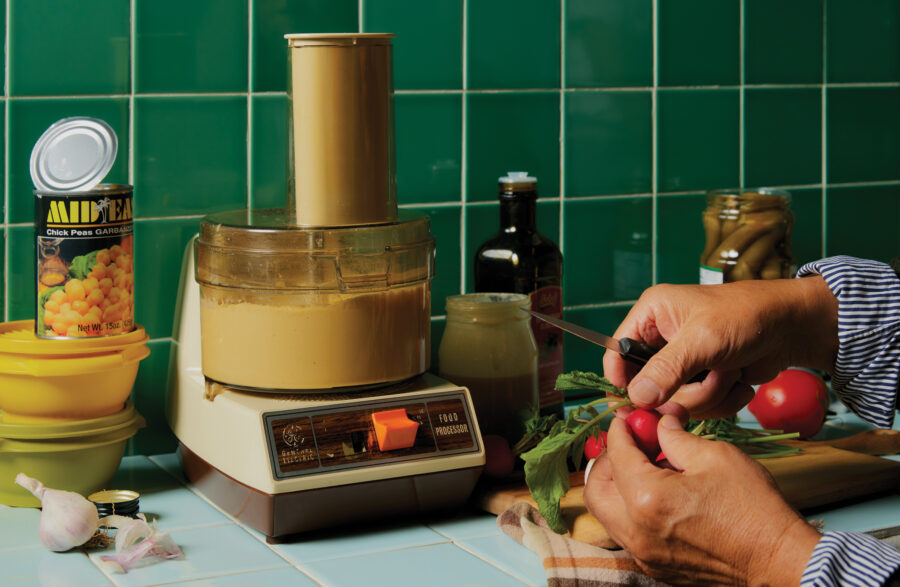
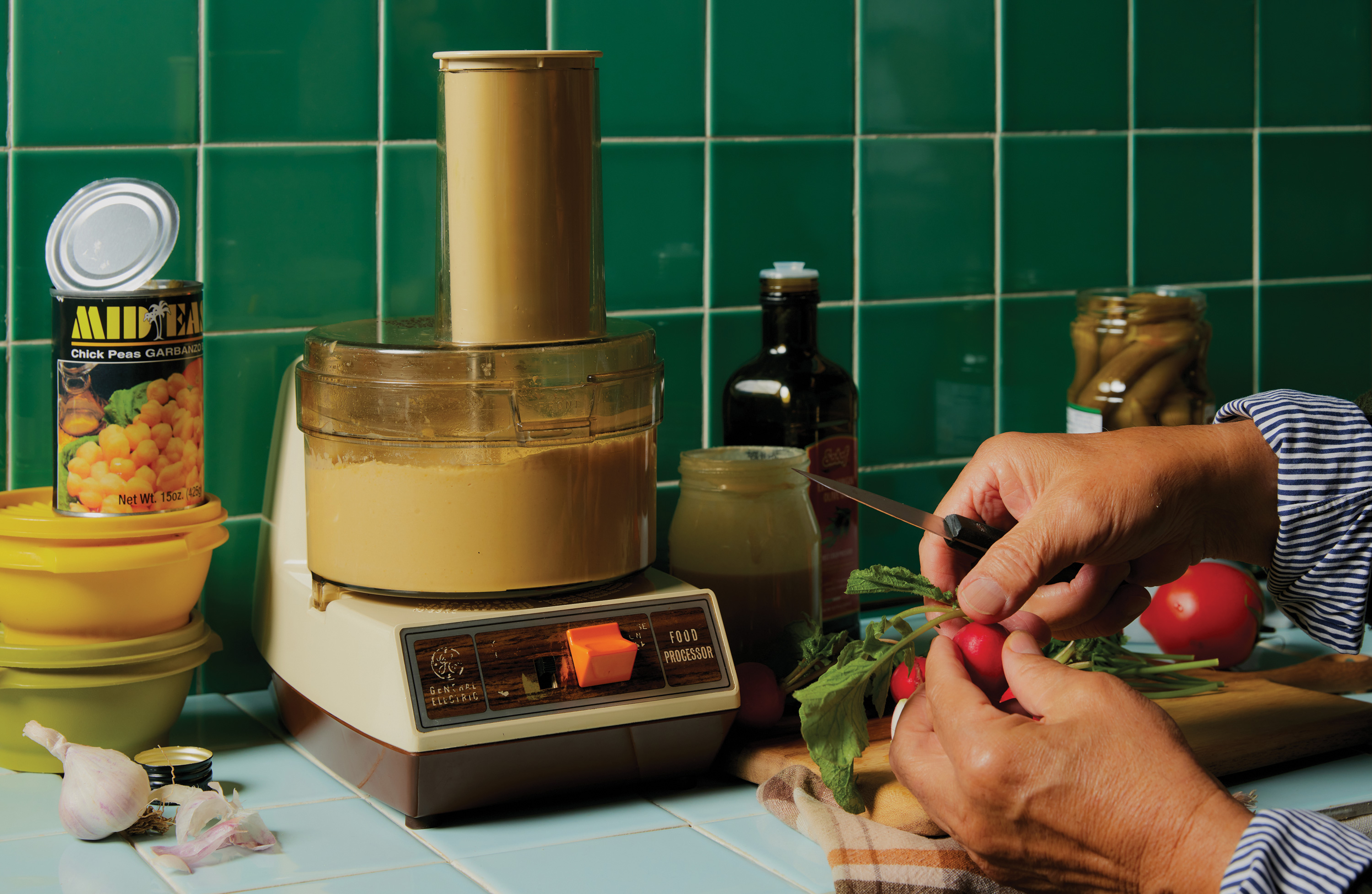
It’s been a long-running joke in my family that every time we have hummus, whether at a restaurant, from a package brought along on a picnic, or even homemade by me, someone will say, “It’s good, but not as good as Grandpa’s!” Unfortunately, it’s true. No hummus will ever be as good as his. Ask me about the ingredients he used and I can list them: canned chickpeas, tahini, garlic, lemon juice, salt, and cumin. Ask me about his technique, and I can explain it: Add small amounts of aquafaba as the hummus blends until you get the right consistency, and let it blend until you can’t stand waiting anymore. But still, I was always missing something. For a while, I blamed the equipment. Grandpa had the same food processor for as long as I could remember. I can clearly see it in my mind, sitting on my grandparents’ tiled kitchen counter, running and running for what felt like an eternity. I thought, If only I had his food processor, maybe I could finally make a hummus that my family would praise as being as good as Grandpa’s.
It’s only been in the past few years that I’ve learned the real reason why, despite my experience and best efforts, my hummus is always lacking.
Grandpa Gregory (Krikor) grew up splitting his time between a house and small farm in Jericho, Palestine, and an apartment in Jerusalem. His parents were Armenians from small towns within the modern-day border of the Republic of Turkey. In the early 1900s, they settled in Jerusalem, along with many other displaced Armenians. Grandpa moved from Israel to the U.S. in 1954, when he was 26 years old. His reason for immigrating was an all too familiar one: Post-formation of the state of Israel, there was a lot of fighting between Arabs and Israelis. He told my dad he just wanted to stop dodging bullets.
As you can imagine, immigrating as an adult meant he brought a lot of his cultural identity and preferences, and a very strong accent, with him. Unfortunately, it also meant that as a young boy growing up in 1960s and ’70’s America, my dad found it very hard to relate to his father: It was the old-country discipline versus the American hippie artist. They would never truly understand each other. And so my dad left home at 20 to pursue a life of pure California, living by the beach and spending his days surfing and eating tacos. In doing so, he disconnected from his father’s history and culture and never looked back. He didn’t bring my siblings and me up with a deep connection to that history and culture, either; it was avocado bagels and smoothies at our house, as opposed to hummus and dolmas.
In spite of my distant and perfunctory relationship with my grandparents, I did look forward to eating those foods whenever we visited their house. And even as a kid, I thought of those dishes as something special, something to be proud of. My grandpa’s hummus platter, in particular, was a work of art that he spent some time creating. He’d make his hummus—always perfectly smooth—and spoon it onto a large plate. He’d then intricately decorate the top with tomatoes, Armenian pickles, radishes, olives, and parsley. To finish, he doused everything in delicious olive oil. I think this was one of the few ways he could show he cared for our family, regardless of his relationship with my dad and us.
It seems obvious now what my hummus lacks compared with his, but until recently, I didn’t have the words to explain it. Because the difference between his hummus and mine has nothing to do with ingredients, technique, or equipment. Instead, it has everything to do with his hands, or, in Korean, his 손맛 “son-mat,” which translates to “hand taste.” This is a concept I learned from my friend Caroline, and I’ve since learned there are sayings in Thai, Hindi, and Latin American Spanish that basically have the same meaning: Each of us lend our unique son-mat to the foods we prepare. And there is no replicating that flavor, no matter how many times someone tries, or how much practical skill they have, or even what food processor they use. Son-mat is that spice you can’t quite figure out, that flavor that when it’s right, you know it’s right. It’s that certain something extra we all search for in the foods that bring us comfort.
INSTEAD, IT HAS EVERYTHING TO DO WITH HIS HANDS, OR, IN KOREAN, HIS 손맛 “SON-MAT,” WHICH TRANSLATES TO “HAND TASTE.”
I will never be able to make my grandpa’s hummus because I don’t have his son-mat. It was his unique hand taste that changed those basic ingredients into something my family fought over every time we went to his house (and I’m not joking, there were arguments about how much and how fast each of us ate). His hand taste developed through his youth in two of the world’s oldest cities, his immigration journey, and the start of a completely new life. Generational trauma, years of unique experiences, a lack of connection (due to distance) to his family, and what I believe to be his desire to show love where his words failed him, all added to his son-mat.
I wish, during all those years I spent trying to re-create Grandpa’s hummus, I had understood son-mat. If I had, I could have just appreciated his hummus while he was still here and known that the absence of it would keep his memory closer to me. These days, I am trying to embrace my own ephemeral son-mat. I put not only my experience and knowledge into the food I make for my friends and family, but also my feelings. I hope when my own kids grow up, there will be a specific dish that will always make them think of me. Son-mat: What a wonderful way to remember a loved one.
There’s more!
But it’s for subscribers. Join to read the story in full, and everything else we publish.
Already a subscriber? Log in
Up Next
Atsuko Okatsuka