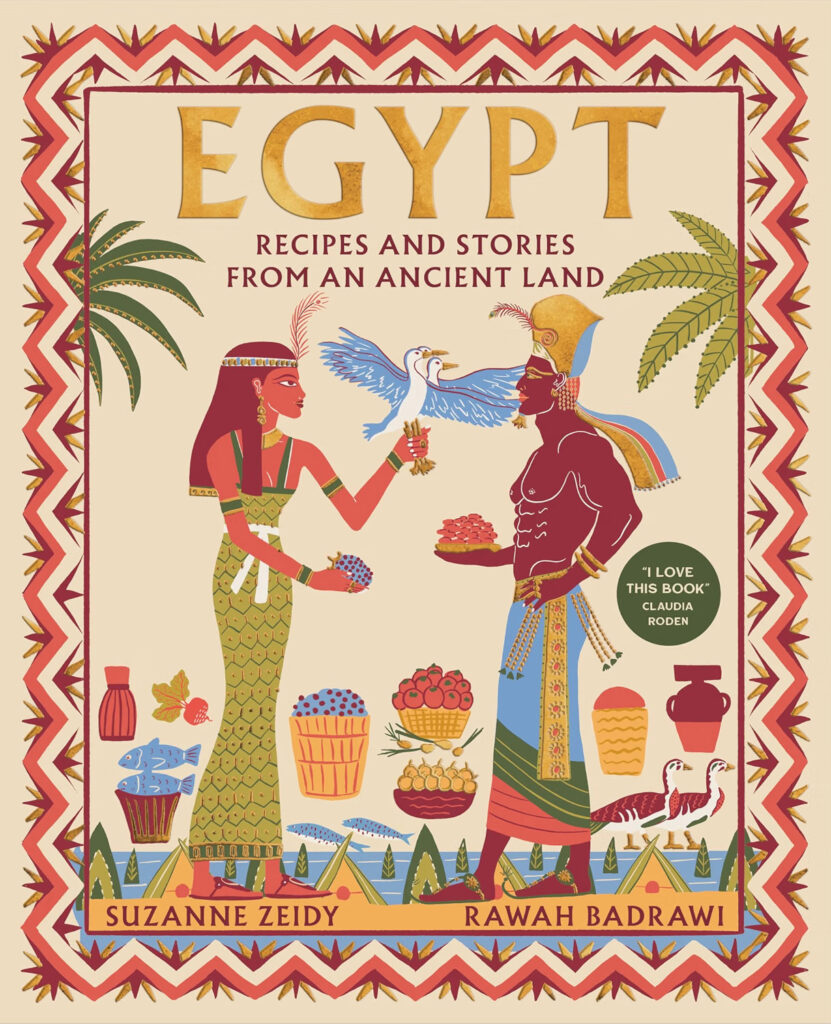
I am half Egyptian, half American. My mother was a Southerner from Georgia; my father is from Port Said on the Mediterranean coast of Egypt. I grew up moving between two worlds and two kitchens—one that seasoned with garlic, coriander, and cumin and another that simmered with bacon fat and spiked with vinegar. I never needed to choose one over the other; instead, I relished the contrast of flavors and rituals. Writing my book Egypt: Recipes & Stories from an Ancient Land with co-author Rawah Badrawi gave me a reason to dig deeper, tracing the stories and legacies behind ingredients rather than just recipes. Along the way, I discovered okra: a humble vegetable so ordinary in both kitchens that I didn’t give it a second thought. However, the more time I spent with communities in Upper Egypt hearing stories of displacement and loss, the more reason I found to linger and learn more.
Okra's journey passes through Aswan and larger Nubia (stretching along the Nile between Aswan in southern Egypt and Khartoum in the Sudan), a culture and homeland that was flooded and scattered by the building of the Aswan High Dam. It also runs through the Middle Passage, the transatlantic voyage that carried enslaved people from West Africa to the Americas, and according to some accounts, carried okra seeds too, hidden in the hair of enslaved women. In the American South, the plant took root again and became gumbo and cornmeal-crusted fried okra, dishes of survival disguised as dinner. These are two kitchens, two displacements, but one struggle. It took me several visits to a village near Aswan to examine okra’s role in history and understand what it represented.
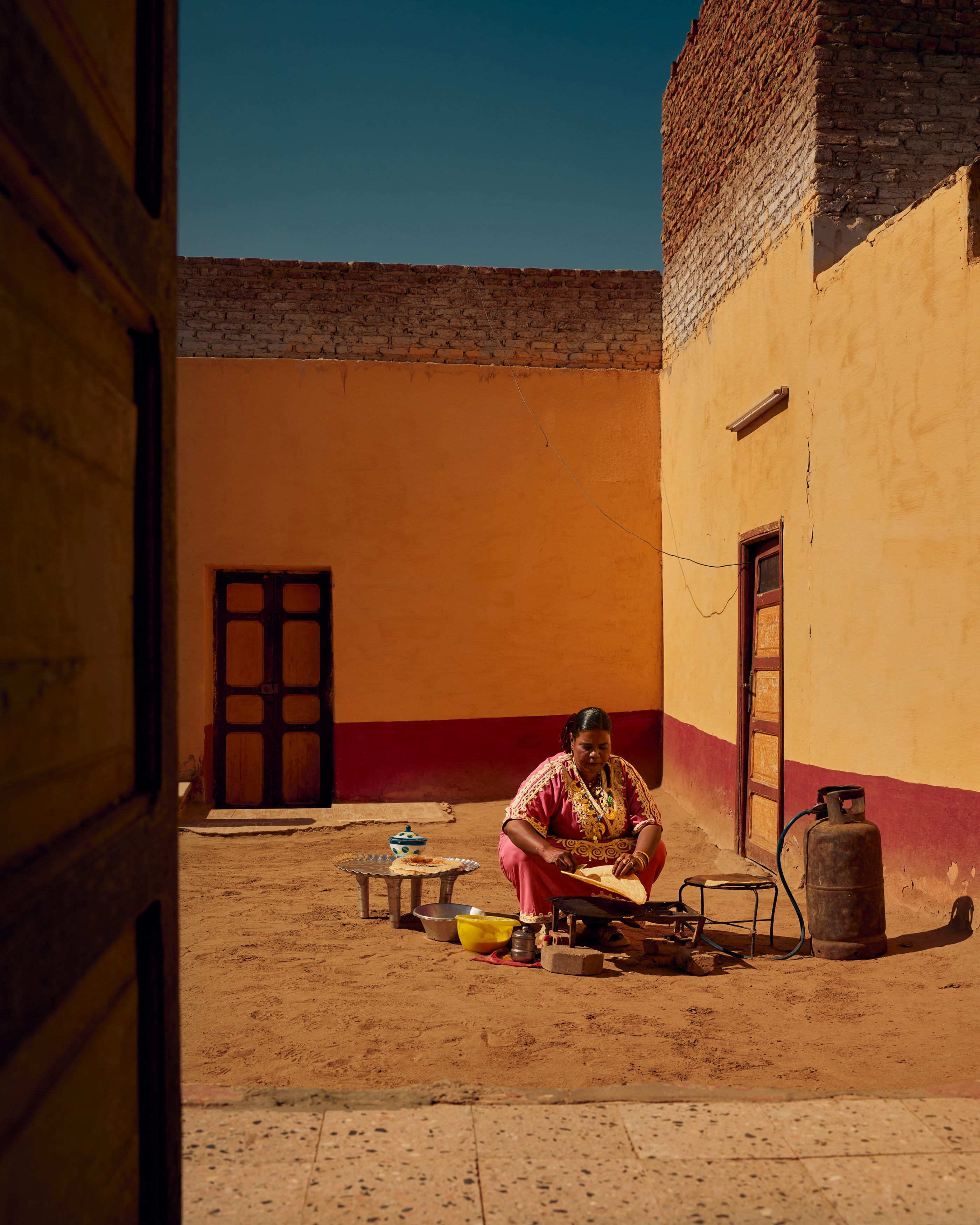
On a sunny January morning in Mesetod, a village sitting on the banks of the Nile near Aswan, Seham moves her kitchen into the courtyard. She cooks the way her neighbors cook—sitting low on a stool, over a flame fed by a battered gas cylinder. Her dried okra stew has been simmering for some time, viscous and thick. The final touch arrives with a sizzle: coriander and garlic fried in ghee, then dropped into the stew with a splash—the tasha as it is known in Egyptian Arabic, creating a lingering scent that signals a dish is ready. When the stew is done, Seham turns to the bread: fitti, a crepe-like flatbread cooked on a griddle called el dew. Soft and malleable, it is the cornerstone of meals here. Nubians tear it by hand and use it to scoop up rich, savory stews from a shared platter.
The dish is called weika. And its story goes back to ancient times.
For more than 6,000 years, the Nile flooded between June and September in a cycle so reliable it became the basis of the Egyptian calendar. The ancient Egyptians called the river Iteru—the Great River—and worshipped it as the ultimate manifestation of Mother Nature. Before the construction of the Aswan Dam, the Nile carried enormous quantities of rich dark sediment past Aswan, depositing it across the floodplain and the Delta each year. This black silt was an extraordinary fertilizer—self-renewing, making agriculture flourish in one of the driest landscapes on earth. A weak flood meant famine. A strong one meant destruction. For millennia, communities along the Nile learned to live within this rhythm rather than against it. Their entire existence—what they grew, when they ate, how they built their homes—was calibrated to the river’s moods.
This was especially true in Nubia.
The Nubian region is one of the oldest continuously inhabited corridors on earth, and one of its most beautiful. Desert cliffs surround the river. Palm trees lean over the water. Feluccas—the traditional sailboats of the Nile—move silently across the current, as they have for thousands of years; their single triangular sails made of Egyptian cotton catching the wind.
The Nubians are among Africa’s most ancient people, their civilization predating even the great dynasties of Egypt. The nub in Nubia means gold, a direct reference to the abundance of gold mines in this region, making it an ancient center of trade and commerce, with a heritage of jewelry production of exquisite detail and beauty.
They built extravagant kingdoms—Kerma, Kush, Meroë—and established urban societies with monumental architecture that rivalled Ancient Egypt itself. They developed their own languages and alphabet, music and instruments, and of course a unique culinary heritage. They were traders, farmers, craftspeople, and formidable warriors.
Along the banks of the Nile, the Nubians farmed in two seasons: shitwi, the winter crops like wheat, barley, and millet, and seifi, the summer crops, fed by the receding floodwaters. Okra was among the summer crops, grown in the heat, then dried and pounded into a fine powder. That powder became the base of weika, and today weika is the foundation of Nubian cooking. Weika is a feminine comfort food, in the deepest sense. Grown, preserved, and cooked by women in a community where men often migrated to cities for work, the kitchen became the center of Nubian cultural life—the place where identity and memory persevered, generation by generation, around simmering pots. That world would not survive the century.
In 1952, the Egyptian revolution brought to power a military regime led by Gamal Abdel Nasser, who was determined to modernize an impoverished, predominantly agricultural country that had only recently liberated itself from colonial rule. The Aswan High Dam was his centerpiece: a vast infrastructure project that promised control over the Nile’s floods, increased water storage for irrigation, hydroelectricity, and the industrialization of Egypt. It also became a geopolitical hot spot. When the United States and Britain withdrew funding after Egypt signed an arms deal with Czechoslovakia, Nasser nationalized the Suez Canal to fund the dam—triggering an international crisis. The Soviet Union stepped in, cementing Egypt’s Cold War allegiance. The dam was as much a symbol of nationalist pride and Third World sovereignty as it was an engineering project. For Nasser, it was the future. For the Nubians, it was the end of the world they knew and loved.
When the first stage of the High Dam was completed in 1964, the creation of Lake Nasser flooded an enormous stretch of the Nile Valley. Over 120,000 Nubians were displaced. Their villages, their farmland, their sacred sites and ancestral graves—all submerged beneath what became one of the largest man-made lakes on earth. Tens of thousands of Egyptian Nubians were relocated to reclaimed land in Kom Ombo, roughly 50 kilometers north of Aswan—away from the silt and flood cycles that gave them nourishment and homes. The land they were given was less fertile, the soil unfamiliar. Promises of return were made and broken. Nubians call this time el hadsa el murra—the bitter event. The phrase says it all.
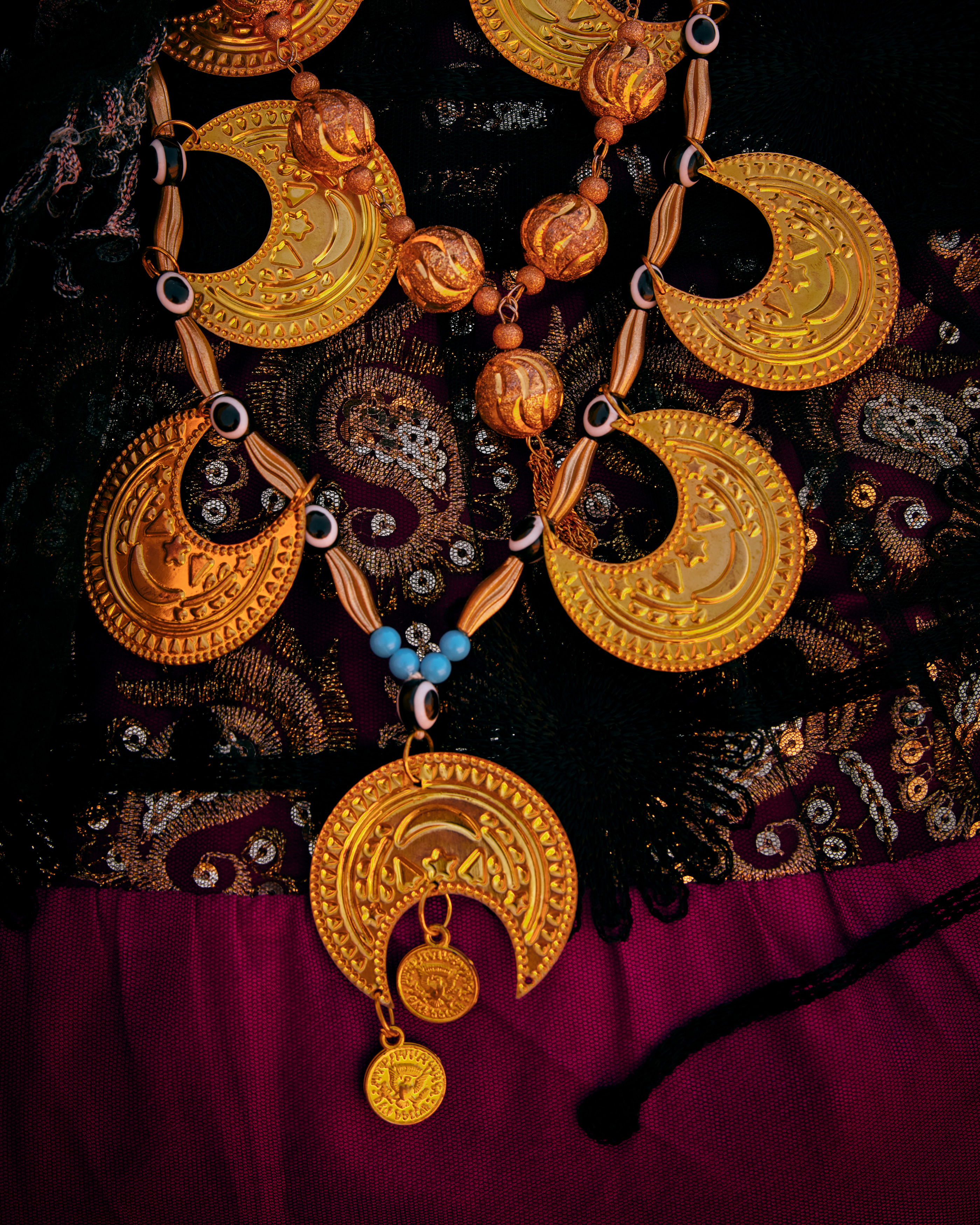
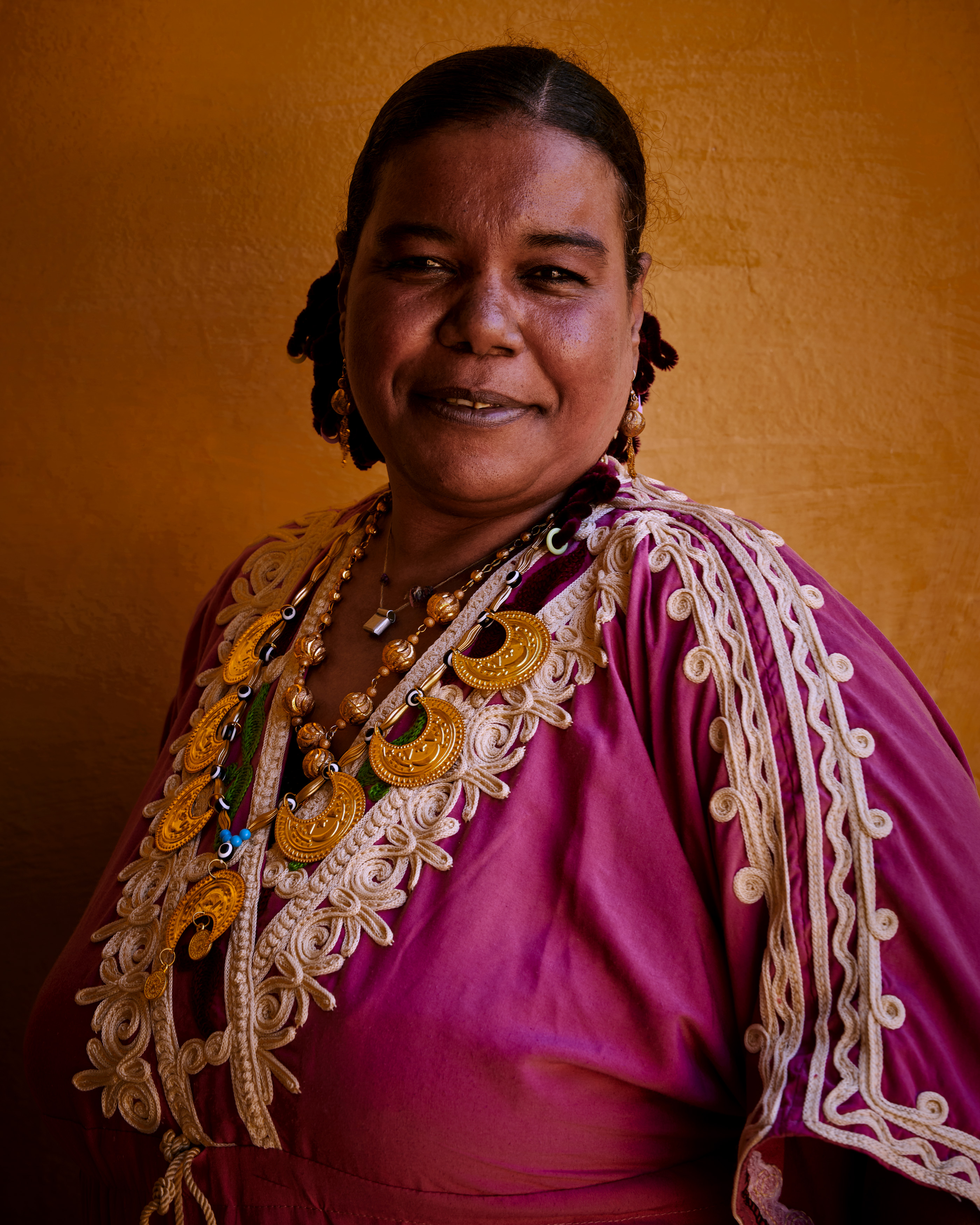
When we visited Seham in her home in Mesetod, she wore her ancestral jewelry: a necklace of gold discs shaped like thick crescents, with dangling charms that caught the light. She touched it gently and said in Arabic so we could understand (her first language is the Nubian Kenzi dialect), “Da min abl el sadd”—this is from before the dam—the time when they still lived on their indigenous land, when their heritage was not something to be preserved but simply lived. After the dam, she said calmly, it all slipped away. What did not slip away was the food.
Nubians are famous for their warm hospitality, and Seham was no exception. She had invited us for a home-cooked meal in her open-air courtyard known as “el housh,” and we had been eager to try weika the way the locals really eat it: scooped up with fitti bread.
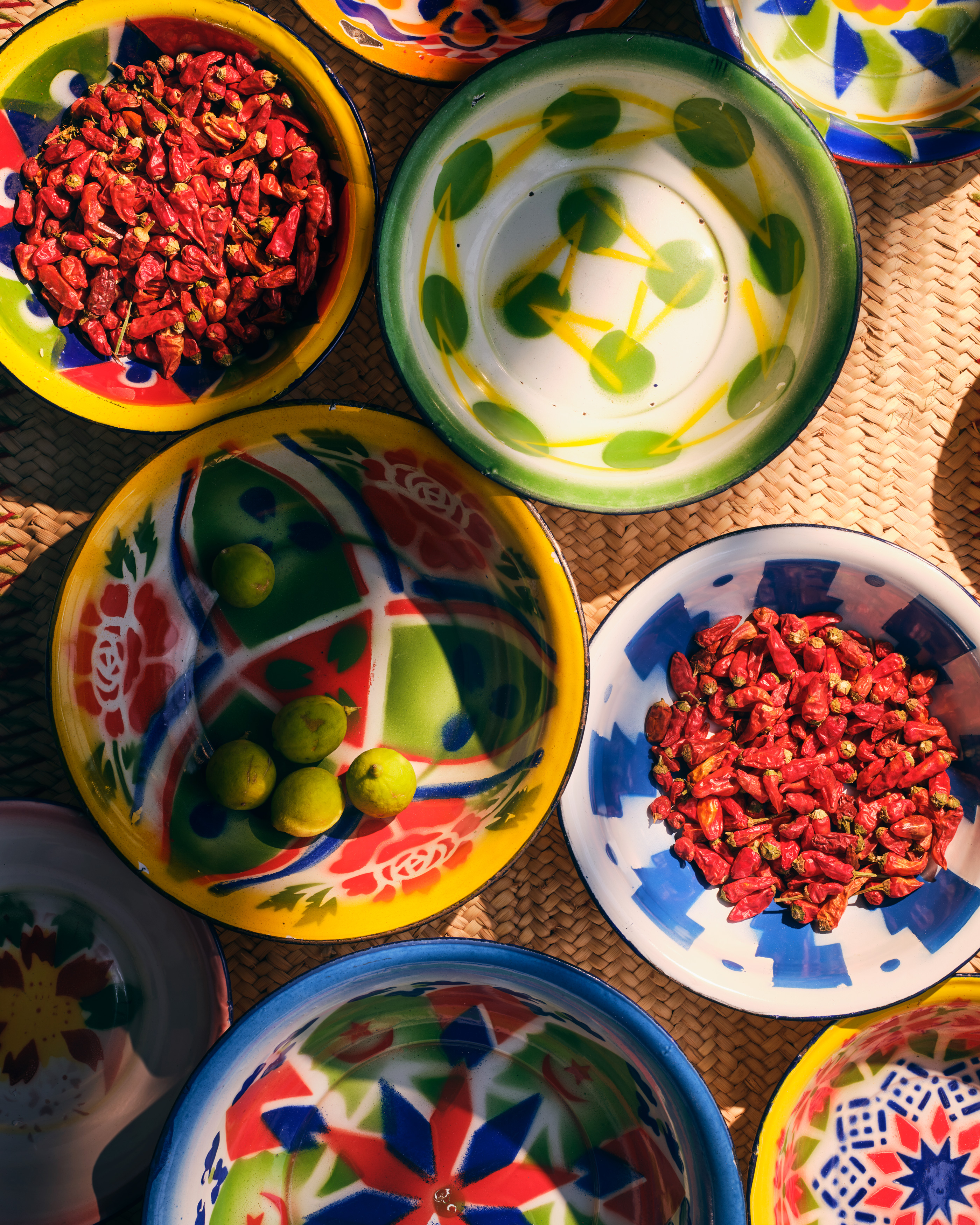
You can buy dried okra by weight at the market these days, but Seham does it the old way. Come summer, she strings fresh okra into necklace-like strands and hangs them to dry in Aswan’s fierce heat. A few days later, once they are crisp and brittle, she pounds them into a fine powder and jars it up to last her through the coming months. That powder becomes the backbone of her okra stew.
The weika she made for us on this January morning was a humble, meatless version: dried okra powder with tomatoes, onions, and spices simmered in broth into something dense and earthy, finished with that signature tasha of garlic and coriander fried in ghee. Watching her plate it up is a ceremony in itself—lining fresh fitti griddle bread on a deep enamel platter, a ladle of stew, another layer of bread on top, then more stew, again and again until the pot is empty. We gathered around her tableya, a low table, under the stars, cross-legged on the mat-covered floor and ate in the Nubian way, huddled close, casually tearing bread by hand and scooping up stew from one large, shared plate. What we were eating, in its rawest state, is easy to overlook.
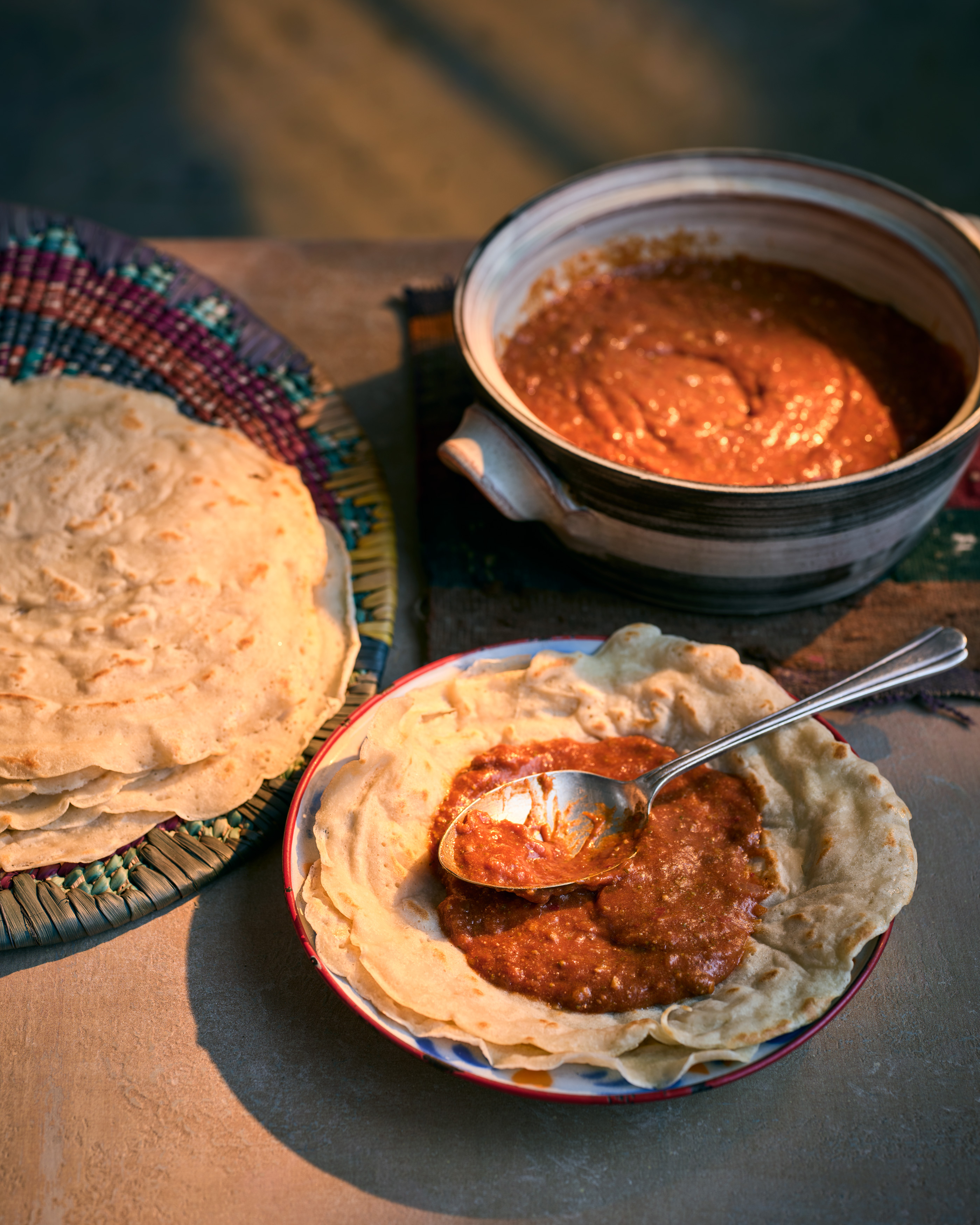
Weika (Nubian Dried Okra Stew)
Serves 4
This recipe comes from the chapter on Aswan in Egypt: Recipes and Stories from an Ancient Land. Dried okra powder gives this stew its distinctive earthy, slightly viscous body. Look for it in African/Middle Eastern grocers or health food stores.
- 2 yellow onions, finely grated
- 2 tbsp ghee
- 2 tbsp oil
- 1 tbsp ground coriander
- 1 tbsp chilli paste or hot pepper flakes
- 4 garlic cloves, minced
- 1l (35fl oz/4¼ cups) tomato passata
- 250ml (9fl oz/1 cup) vegetable stock
- 2 heaped tbsp dried okra(weika, see note below)
- ½ recipe quantity Fitti Griddle Bread(see recipe below)
- Sea salt and ground black pepper
for the tesha
- 1 tbsp ghee
- 1 tbsp oil
- 6 garlic cloves, minced
- 2 tsp ground coriander
In a saucepan over a medium heat, sauté the onion in the ghee and oil until golden—about 5 minutes. Season with salt and pepper and add the ground coriander and chilli paste or hot pepper flakes, stirring. Add the minced garlic and cook for a few minutes until fragrant, then stir in the tomato passata. Reduce the heat and let it simmer for about 30 minutes, until the sauce has thickened and reduced—this seasoned tomato base is known in Egyptian cuisine as tasbika. Pour in the stock and bring to a boil. Add the weika (dried okra powder), whisking well to prevent clumping, then reduce the heat and stir until the stew thickens.
To prepare the tasha, heat the ghee and oil in a small frying pan. Add the garlic and sauté until fragrant, then add the coriander and cook until golden brown. Pour the entire mixture into the okra stew, stirring to blend the flavors.
To assemble, line a deep serving dish with a piece of flatbread, letting the edges hang over the sides to form a bread “bowl.” Ladle in some weika stew, then place another piece of flatbread on top, followed by another ladle of stew. Continue alternating layers of bread and stew about 4–5 times, finishing with a generous serving of stew on top. Traditionally, this dish is eaten by hand: diners tear off pieces of bread to scoop up the thick stew.
Note: To make dried okra powder yourself, simply slice fresh okra and lay the pieces flat on a baking sheet to dry at room temperature over several days—or speed up the process by drying them on your oven’s lowest setting for four to five hours. Once completely dry and crisp, pound the okra to a fine powder and store for up to three months in an airtight container.
Okra (Abelmoschus esculentus) is a tall, heat-loving flowering plant in the mallow family, related to cotton, hibiscus, and cocoa. Its ribbed pods, when cut, release a viscous, mucilaginous (aka “slimy” to most of us) liquid that is polarizing to those unfamiliar with it and irreplaceable to those who know what it does: thicken soups and stews into something deep and satisfying.
It is still debated where exactly okra originated. The most widely cited theory points to the Ethiopian Highlands, where the greatest diversity of wild okra relatives has been found. Another school of thought points to West Africa, where the greatest diversity of cultivated varieties exists. The most current scientific thinking, from Kew Gardens, proposes that okra likely originated across the entire Sahel belt—the semi-arid band of land stretching from Senegal eastwards to Ethiopia, with the Sahara to the north and the more humid savanna to the South—which essentially encompasses both arguments. Ultimately, it is an African plant.
What is beyond dispute is how it travelled. The word okra is likely derived from okwuru, the name for the plant in the Igbo language of Nigeria. The word gumbo—the Louisiana stew in which okra is the defining ingredient—comes from ki ngombo, the word for okra in Bantu languages of Angola and the Congo. These names crossed the Atlantic and in the memory of enslaved people. They had little else but the knowledge of what they had always grown and how to cook it.
Culinary historian Michael W. Twitty, in his James Beard Award–winning book The Cooking Gene, traces how enslaved Africans brought their seeds, their knowledge, and their foodways with them across the Middle Passage. Okra was among the few crops they could carry. Thanks to the long growing season and mild winters of the American South, it took root. Enslaved people were stripped of their names, their gods, their languages, and their freedom, but not their food. That food became the form in which memory, resistance, and continuity survived. For Twitty and other food historians, okra has become a living emblem of the African American identity and the memory of Africa in a displaced community. While okra’s westward journey to America is well documented, its eastward one, to the Nile, is not.
Okra did not have far to travel to arrive in Egypt. The earliest written record comes from 1216, when a Spanish Moor visiting Egypt described seeing it cultivated by locals along the Nile. But accounts differ on when it actually arrived there, with some sources placing Egyptian cultivation as far back as antiquity and others arguing it wasn’t introduced until the 7th-century Muslim conquest. What is rarely asked is when it arrived in Nubia. Given Nubia’s proximity to the plant’s likely place of origin, it may be that okra was growing there before it ever reached Egypt at all—a possibility no written record can confirm, but one that geography makes hard to dismiss.
Weika and gumbo are not the same dish. But they are kin. Both are built on okra’s capacity to hold everything together, to thicken and deepen whatever it touches. Both tell stories of displacement, and both represent the palate of a people who refused to be erased. Okra has always thrived in the hands of those who had little else—those who hung its pods in open-air courtyards to dry, who knew how to pound it, and transform it, and those who carried its seeds across oceans. They created something nourishing and enduring in the face of dispossession, heartache, and loss.
Aish Fitti (Fitti Griddle Bread)
Makes about 10–12 large flatbreads
- 520g (1lb 2½oz / 4 cups) plain (all-purpose) flour
- 1 tsp salt
- 1 tbsp dried yeast
- 1 tbsp sugar
- Oil, for greasing
Combine all the dry ingredients in a large bowl. Gradually add 800ml (28fl oz/3½ cups) water, whisking constantly to prevent lumps. Whisk until the batter is smooth and resembles thin pancake batter—you may need slightly more or less water depending on your flour. Keep it slightly thicker than the final desired consistency, as it will loosen during proofing. Cover and let rest in a warm place for 1 hour. After resting, whisk again to deflate.
Heat a large griddle or frying pan (large enough to fit a 30cm/12in flatbread) over medium heat and oil the hot surface using kitchen paper.
Use a small heatproof cup or ladle to spread the batter evenly into a 30cm (12in) diameter circle in the pan. Smooth out any holes with the ladle’s bottom. Cook for 2–3 minutes until golden, then flip and cook the other side until equally golden. Stack the flatbread on a plate, and cover with a napkin. Repeat to cook the remaining batter, reoiling the pan between each bread.
Recipes reprinted from Egypt: Recipes & Stories from an Ancient Land by Suzanne Zeidy and Rawah Badrawi with permission from Nourish Books.
Up Next
Chaos Agents