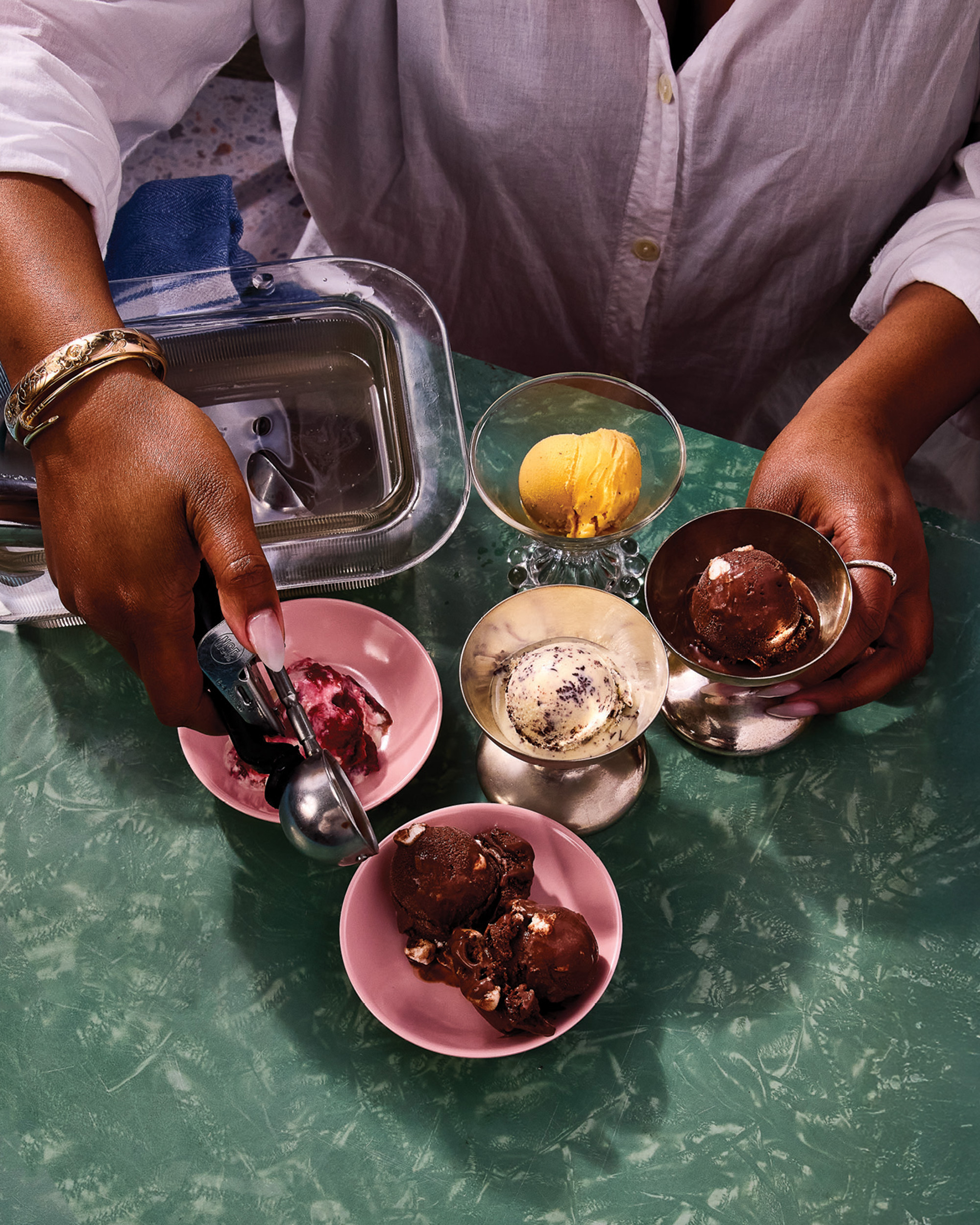
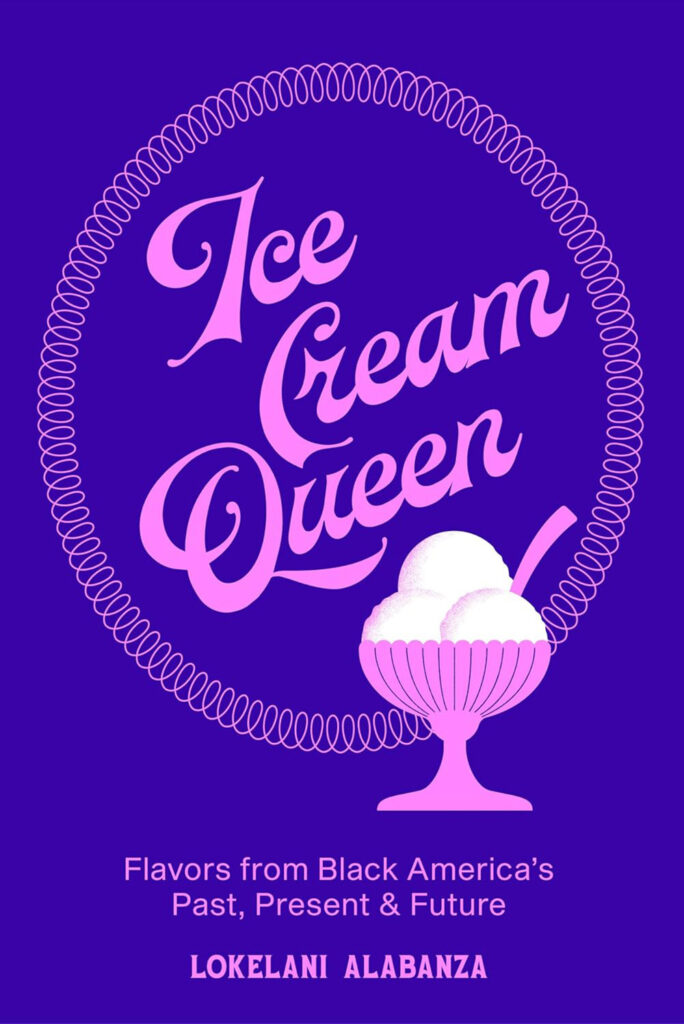
The second I snagged the galley of Ice Cream Queen, I knew this drop would amplify a long-told story in Black foodways. At first glance, it fits snugly into the current rolodex of new cookbook releases, embracing a visually eye-catching editorial style, think: saturated, flash-hefty photography, glitzy colorways, and statement-making fonts. This look channels a spirited, almost rebellious energy, breaking from the minimalism of past decades in favor of unapologeticness. Yet Lokelani Alabanza flips the script almost immediately.
Alabanza’s debut cookbook isn’t just another pretty prop for your shelf or coffee table. Instead, the acclaimed pastry chef delivers strategically curated archival research laying out the truth: ice cream, as we know it, exists because of both the histories of colonization and enslavement and the fierce ingenuity of Black folks.
Chalk it up as essential reading. For those unfamiliar with Black history, the truths Alabanza presents may come as a revelation. For those of us who have long refused to stay silent about Black ingenuity and innovations that rarely get their due, it’s refreshing to see the real story finally acknowledged and uplifted. Between pages that teach you how to turn brewed bags of Lipton tea into a creamy custard or transform Prince’s famous fried chicken skins into an ice cream topping, you’ll also stumble upon archives that document what we’ve always known: Black people have been pioneering, even through trying times. Food is never just sustenance for us; it’s grounded in centuries of struggle and ancestral wisdom that guide us through it all.
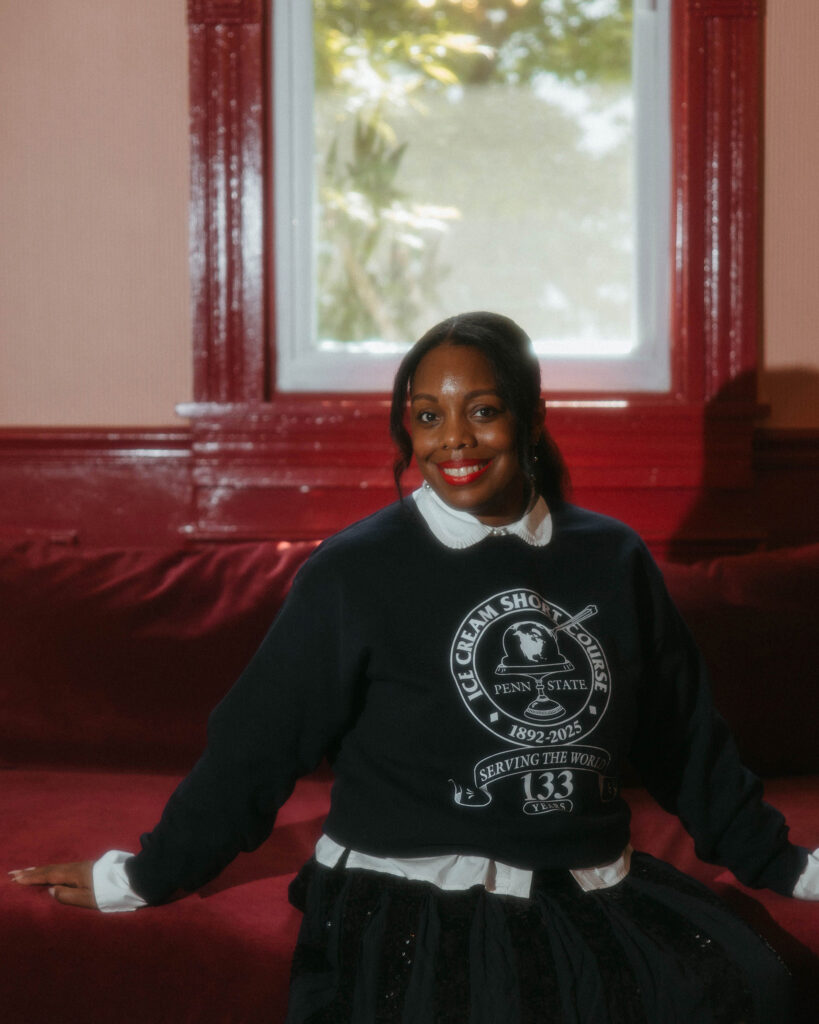
Ashia Aubourg Looking back on your upbringing, what experiences or pivotal moments do you feel most shaped the path that ultimately led you to write Ice Cream Queen?
Lokelani Alabanza Oh my gosh, it was most certainly watching my grandmother cook in the kitchen. I grew up in the ‘80s and just remember her yellow kitchen, the tulips on her curtains, and her oven. Being around her just planted a seed.
I was an only child at the time, and my grandmother raised me. Growing up, I was so curious. I would play Trivial Pursuit by myself. I was always intrigued by stuff. And I just loved the fact that people could be in the kitchen. They were talking to you about food, and then all of a sudden they made this thing.
At the time, I didn’t think about being a cook. But it was something that I was very unconsciously enamored by. There’s nothing like a grandma’s kitchen. I just remember her sitting, talking on the rotary dial phone, and twisting her fingers.
And then, when I would go see my dad’s Filipino side of the family in San Francisco, it was really interesting to eat dishes like lumpia, puta, and fried snapper. And my mother is an extraordinary cook. She loves a flavor profile. I almost think that she probably could have owned a restaurant or something in the food world, because she’s just so naturally gifted. So growing up, food was always around me.
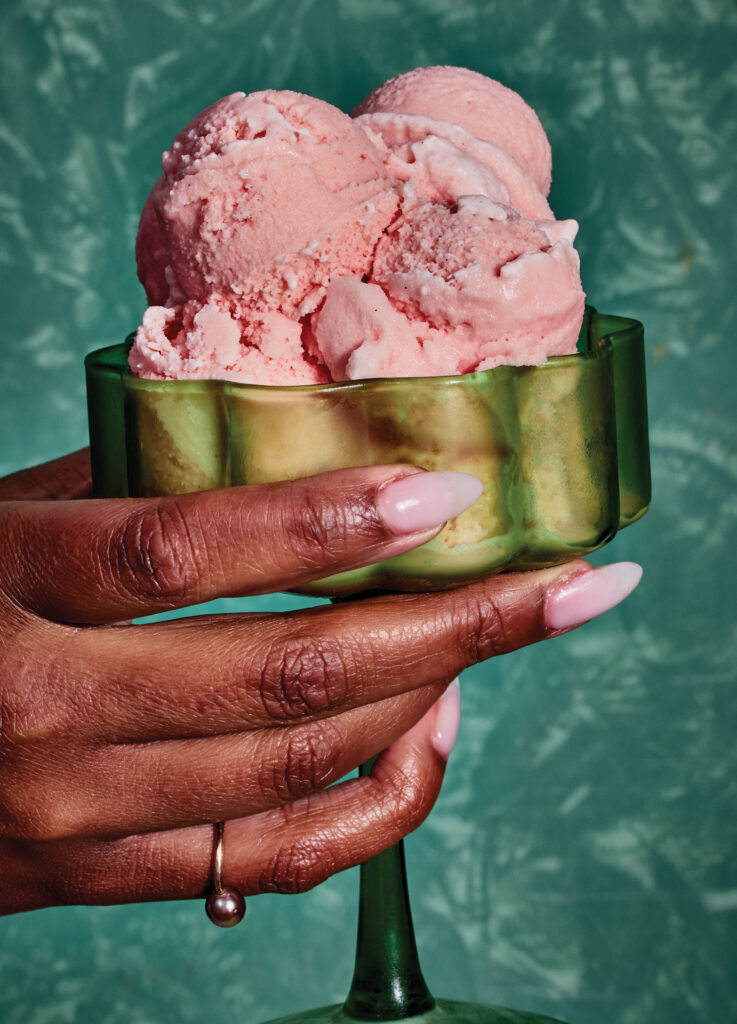
Salted Watermelon
Makes about 1 ½ quarts
In a word, watermelon is complicated for the Black community. A lot of us, especially the over-sixty-fives, eat it only at home—away from public view. There’s nothing inherently shameful about the act; in fact, as a popular cash crop for newly freed Black Southerners, it was initially a symbol of their post-Civil War economic indepen-dence. But resentful Southern whites pushed back with stereotypes of Black people as lazy, simple, and obsessed with eating watermelon, and caricatures of dark-skinned people with big bulging eyes and juice-stained mouths circulated around the world through songs, films, and postcards for more than a century. Even President Barack Obama was subjected to similar caricatures during his election campaign in 2008.
So how does one take that power back? How do we transcend this trauma? For me, that means embracing watermelon in my own recipes and encouraging people to enjoy it without shame. I don’t want to erase the awful history of the stereotype: More than anything, this recipe was made to celebrate the men and women who endured those times.
- 3 cups Fresh Watermelon Juice
- ¼ cup crème fraîche, at room temperature
- 1 tablespoon fresh lime juice
- 2 teaspoons kosher salt
- 1 recipe Vanilla Ice Cream Base(see below)
Combine the watermelon juice, crème fraîche, lime juice, and salt in a medium bowl. Whisk the mixture into the ice cream base.
Cover with plastic wrap and refrigerate for at least 1 hour or, pref-erably, overnight to let the flavor develop.
Mix the ice cream base in a blender (or with an immersion blender) for 30 seconds. Pour into an ice cream machine and follow the manufacturer's instructions to freeze until the mixture thickens, 25 to 30 minutes depending on your machine.
Scoop the ice cream into a freezer-proof container. Cover with parchment paper or plastic wrap to prevent ice crystals from developing on the top of the ice cream and close with an airtight lid. Freeze for 4 to 6 hours or overnight before scooping.
Ashia What inspired you to explore the intersection of ice cream, history, and Black identity, and at what point did you realize this story needed to become a book?
Lokelani When I embarked on this journey of ice cream, I tell everybody it found me. Twenty years ago, if you would’ve told me I would create a cookbook about it, I’d be like, ‘There’s no way.’ I knew I always wanted to write one, though. I love food history. But while I was in culinary school, no one was talking about Black food history.
Ashia Oh—food justice wasn’t exactly a huge topic. When I enrolled in Syracuse University’s food studies program back in 2018, I became the first person in the school’s history to declare it as a major. It just goes to show how new and emerging this field still is.
Lokelani I get it. When it came time to tell my story, even down to my proposal, I had to figure out how to talk about all of these things. The book began to shape itself over time. So at first, I had these photographs. Then, I had this idea. Like, ‘I know I’m in ice cream. I want to talk about Black people; I want to talk about hard things, but there’s joy in it all.’
Ashia I love that because even when I was looking at the proof, I realized it’s not formatted like your average cookbook, but I appreciate that. It’s almost like a historical guide. Which brings me to my next question: A central figure you credit with inspiring Ice Cream Queen is Sarah Estell. What does it mean to you to carry forward her legacy, and the legacy of so many other Black confectioners whose contributions to culinary history have often gone unrecognized?
Lokelani So I learned about Sarah when I spotted this beautiful picture of a group of Black kids eating ice cream on eBay. I was like, ‘Who bought this picture?’ I’m a researcher by nature. And so I’m often on the hunt for photos.
So I learned that [Sarah] owned an ice cream saloon and a boarding house. I wrote down the addresses: 89 North Cherry and 39 North Summer [in Nashville, Tennessee]. Later on, I picked 89 Cherry Street as the original title of this book because Sarah lit this fire. I was so intrigued that she was in the same city as me, just 175 years prior. So learning about her just unlocked so many doors. I then discovered Kit Baldwin, who owned Baldwin Ice Cream on Chicago’s South Side in 1921.
For me, it was important to preserve that continuation. Because we know Ben and Jerry’s name, right? But if I ask somebody to name a Black ice cream manufacturer or a Black-owned ice cream shop in their neighborhood, they’re silent.
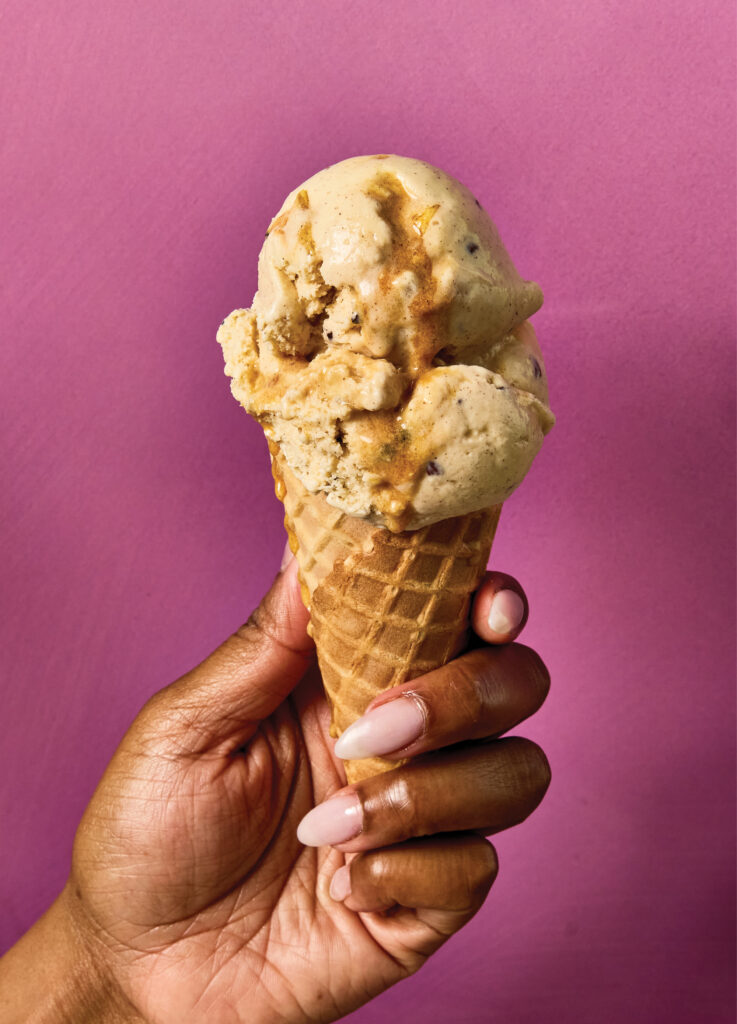
Honeycomb, Vietnamese Cinnamon & Cacao
Makes about 1 ½ quarts
Making honeycomb candy feels like straight-up alchemy, despite being so simple: Whisk baking soda into hot caramel, watch it bubble, then pour it onto a baking sheet in a golden, foamy glob. When it cools and is broken open, the holey shards resemble bits of beehive. When mixed into an ice cream base, the shards become like liquid gold, melting into little pools of caramel. This ice cream is a tribute to the magic of honeycomb and the patience of Elizabeth Belkind, the incredible pastry chef who taught me how to make it.
- ½ cup sugar
- ½ cup light corn syrup
- 1 tablespoon honey
- 1 tablespoon baking soda, sifted
- 1 recipe Vanilla Ice Cream Base(see below)
- 1 tablespoon freshly grated or pre-ground Vietnamese cinnamon
- 1 tablespoon cacao nibs
Line a rimmed baking sheet with parchment paper or a silicone baking mat.
In a small, heavy-bottomed pot, combine the sugar, corn syrup, and honey. Bring to a boil over medium heat and attach a candy thermometer. When the temperature reaches 300°F, also known as the “hard crack” phase, carefully whisk in the baking soda. Remove from the heat. The mixture will foam and start to turn yellow.
As the mixture rises to the top of the pot, carefully pour it onto the prepared baking sheet. It will be very hot. Let the honeycomb cool completely, then break it into pieces. The honeycomb will keep for up to a week in an airtight container at room temperature.
Mix the ice cream base and cinnamon in a blender (or with an immersion blender) for 30 seconds. Pour into an ice cream machine and whisk in ½ cup of the honeycomb pieces and the cacao nibs. Follow the manufacturer’s instructions to freeze until the mixture thickens, 25 to 30 minutes depending on your machine.
Scoop the ice cream into a freezer-proof container, layering as you go with another ½ cup of the honeycomb pieces and ending with ice cream. Cover with parchment paper or plastic wrap to prevent ice crystals from developing on the top of the ice cream and close with an airtight lid. Freeze for 4 to 6 hours or overnight before scooping.
Ashia In your book, you examine four foundational ingredients of ice cream: sugar, salt, vanilla, and ice, and trace their connections to systems of enslavement and forced labor. What do you hope readers take away after learning this often-overlooked history?
Lokelani There’s no way to write a book about Black Americans’ contributions to ice cream and not talk about the big elephant in the room.
Sugar is responsible for the centuries-long enslavement of Black people. I had to tell this part of the story because knowledge is freedom. I talk about the ice industry, which Black people were forced into under horrible working conditions. And you can’t talk about vanilla without talking about a 12-year-old enslaved child’s ingenuity and, at the same time, cruel treatment. So it was really important to drive into the history of the different ingredients and how they impact us today. Food is political. And my dear sister, best we talk about it all the time.
Ashia Absolutely. So, as I was flipping through the pages, I came across some pretty amazing recipes. What continues to inspire you as you develop new recipes and flavor combinations?
Lokelani This book contains the contents of my head. I always laugh because I was that weird Black child with all my friends growing up. I gravitate towards weird. Like right now, I’m trying to make a flavor inspired by the crystal store. Anything can inspire me. [Since] I figured out the science behind the base [of ice cream], I’ve made over 400 flavors so far. I’m always thinking about how to push flavor profiles.
Ashia I noticed that the recipes in the book can be made either with an ice cream maker or with a freezer-safe container. Why was it important to you to make ice cream accessible through both methods?
Lokelani Rufus Estes published the beautiful book [Good Things Eat] in the 1900s. He has 20-something ice cream recipes in it. So, the no-churn recipes in this book were really an ode to him. I love them; they’re so easy.
Ashia After all these years of making and tasting ice cream, what flavor are you most excited about right now? I know this is probably like asking you to pick your favorite kid.
Lokelani Right now, I’m loving soft serve. Also, since it’s summer, I’ve been feeling rosewater. I make a strawberry rosewater jam. It gives ice cream a nice, light flavor. Oh, and also anything pineapple like Dole Whip.
Ashia Tell me about Saturated. What inspired you to create a plant-based, CBD-infused ice cream brand, and what gap did you see in the dessert market that you wanted to fill?
Lokelani At Campanile [where Alabanza previously worked], I experimented with one of their coconut ice cream bases and got really excited. I pushed it a little bit and made a chocolate version, and I just remember calling my dad and telling him about it, and he quickly told me I needed to start a company. Then, maybe two weeks later, he sent me an ice cream machine.
Around the same time, I was visiting a dear friend who had passed away from cancer. I remember thinking how nice it would’ve been for her to have medicinal ice cream in her last days. So that’s how I got started. I did mainly events and pop-ups, but I would love to find a manufacturer to expand the business.
Ashia What flavors from Saturated are you most excited for people to try, and what makes them stand out?
Lokelani I’m really excited to get a magnolia and indigo flavor out there. I always walk down the ice cream aisle in any store and think to myself, ‘It’d be fun to see a hot chicken flavor in the freezer.’
Ashia I fear that once this cookbook becomes more popular, people will want to see your ice cream in the freezers.
Lokelani I mean, if anyone wants to talk. I’d love that. I love that call to action.
Vanilla Ice Cream Base
The story of vanilla begins in hardship; it is the story of a spice that young enslaved Black hands cultivated under brutal conditions.
And then, it transcends—vanilla became a flavor Black American hands would produce in their shops, scraping the precious tiny beans out of their thin dried stalks and turning them into a delicious, creamy miracle.
No two vanilla ice creams are the same, and taste depends entirely on the quality of the vanilla you’re using. What distinguishes this recipe from the vanilla bases you might’ve made in the past is that it has the ability to transform into any flavor you want it to be.
Here I suggest Madagascar vanilla, which tastes creamy with hints of tobacco, but I invite you to try different types of vanilla as you make this again and again.
- 2 cups heavy cream
- 1¾ cups whole milk
- ¼ cup sugar
- ½ cup tapioca syrup or light corn syrup
- ½ teaspoon kosher salt
- 6 large egg yolks
- 1 tablespoon Madagascar Bourbon vanilla paste or seeds scraped from 1 vanilla bean pod
To make a plain ice cream base, simply omit the vanilla in this recipe.
In a medium, heavy-bottomed pot, bring the cream, milk, sugar, syrup, and salt to a boil. Whisk occasionally until the sugar has dissolved.
Set up an ice bath: Put a medium stainless-steel bowl in a large bowl filled with ice water. Set a fine-mesh strainer next to the ice bath.
Temper the egg yolks: Whisk the yolks in a small bowl. Slowly add ½ cup of the hot milk mixture to the eggs while whisking. This allows the yolks to heat up slowly so they won’t curdle when you add them to the pot of hot milk. Remove the pot from the heat.
Whisk in the egg mixture until combined. Return the pot to the stove over medium-low heat. Using a heatproof spatula or your favorite wooden spoon, stir until the mixture thickens slightly and reaches 160°F, making sure the mixture doesn’t curdle.
Strain the mixture into the bowl set in the ice bath. Whisk in the vanilla. Cool the mixture, stirring from time to time, until it is cold, then remove from the bath. Cover with plastic wrap and refrigerate for at least 1 hour or, preferably, overnight to let the flavor develop.
Up Next
Shave Makers